Saturday, March 14, 2009
The Other Side of Life in China
No flashy pictures or dramatic tales from clinic this time, just an awareness that today marks the one year anniversary of the Tibetan uprising and riots that led to many deaths and untold human rights abuses at the hands of the Chinese government last year. Recently, the Chinese government has prevented the Tibetans from celebrating their annual prayer service and is cracking down on any of their attempts to gather together. We are living in a province that borders Tibet, and can see the ripples of this here. There is a 'Tibetan' quarter in Chengdu, and when Ian and I tried to go there yesterday we were stopped at a police barrier by an undercover officer. Nothing was said, just an arm raised, barring us from entering the street. Other ethnic 'Han' Chinese and Tibetans were allowed to pass, but it seems that foreigners are being targeted in this instance. We (foreigners) have not only been expelled from Tibet in recent weeks, but are being denied access to areas that are deemed 'sensitive' in an attempt to prevent/squash potential demonstrations, international attention/press, and the bearing witness of Chinese policy towards the Tibetans in action. So, this morning while out walking, I wasn't surprised to see police cars and officers milling around street corners where I've never seen them before. No doubt they're reinforcements sent to help suppress any acknowledgment of last year's massacre, this year's prohibition, or the 50 year anniversary of the Dalai Lama's forced exile which also is being observed this March.

Saturday, March 7, 2009
BIG Buddha!
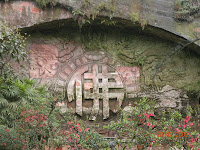
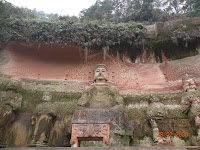
As we have now settled into our school schedule our opportunities to travel are somewhat limited. Fortunately for us, there is a fair bit to see nearby to Chengdu. Last weekend a group of us went to Leshan, about 1 hour away, to see the worlds largest seated Buddha statue. Along with the seated buddha, there were numerous temples and buddha carvings throughout this 'Buddha theme park'.
The big Buddha was built in about 90 years and was completed about 900 years ago. It sits 70 m tall, and has ears 7 m long. It was impressive to say the least, and a great day spent, I'll let the pictures speak for themselves. It was also a great chance for me to try out my new camera. It is able to shoot picture in color and black and white at the same time. The black and white effect is kind of nice to capture the serenity of the Buddha.


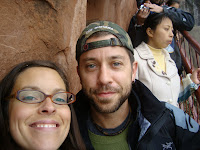


The Monk who had the vision for the big Buddha. He had an idea, that by building the buddha at the convergence of the 3 rivers it would calm the waters and save the lives of fisherman who were being killed in the strong currents.
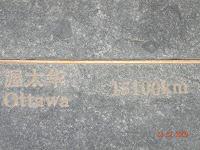

A marker at the Buddha shows up that we're a long way from home and Brazil!





I hope you are all well.
Zai jian.
Ian
The big Buddha was built in about 90 years and was completed about 900 years ago. It sits 70 m tall, and has ears 7 m long. It was impressive to say the least, and a great day spent, I'll let the pictures speak for themselves. It was also a great chance for me to try out my new camera. It is able to shoot picture in color and black and white at the same time. The black and white effect is kind of nice to capture the serenity of the Buddha.


The Monk who had the vision for the big Buddha. He had an idea, that by building the buddha at the convergence of the 3 rivers it would calm the waters and save the lives of fisherman who were being killed in the strong currents.


A marker at the Buddha shows up that we're a long way from home and Brazil!


I hope you are all well.
Zai jian.
Ian
Thursday, February 26, 2009
Welcome to TCM, Chinese style!
Okay, so Ian's done this rockstar job of keeping you all in the loop with our travels....I'm both thankful, and feeling the ever-expanding shoes to fill!


Our Gang from Victoria; Our Gang and some of our translators; the outside of the hospital, the Herbal Dispensary; patients waiting for their herbal formulas
This story will be brief (okay, probably not), but not without it's share of gory details about our first two weeks of clinic in China! Nothing short of amazing...in so many ways and on so many levels. Our group from Victoria has been split into three, each with it's own translator and following it's own set of Doctor's for the week. One group's experience is not necessarily another's, so we are never short of stories to swap at the end of each morning. The Doctors in the 'out patient' ward (where they collectively treat over 4000 patients per day) begin their day at 8am and see patients continuously until noon. For some, like Dr. Hu that I followed this morning, she had already treated more than 50 patients by 10:30am....FIFTY PATIENTS! (I hope that Health Canada isn't watching). They have a 2.5 hour lunch break (during which many of them take a nap, I'm told), and then treat patients again from 2-5pm, 5 days a week. The rooms are absolutely jam-packed with people, some having treatments, some awaiting treatments and several interns busily assisting the Doctor. With the addition three rather large Canadian interns (in comparison...wow, I've never felt so tall), you can imagine the kind of jostling that goes on throughout the morning.
Patients are treated for any number of conditions, but, facial paralysis and hemiplagia (one-sided paralysis) make up 90% of what the Doctor's in these wards treat. 90%!!!!! It's incredible. Row upon row of people, young (as young as 4 months) and old, have needles inserted all over their faces and scalp and are then hooked up to electrical stimulation machines that send a current through to the points at regular intervals. Frankenstein has nothing on China.
Some Doctors use other manipulation techniques as well - flash cupping on the face (I hope to post a video of it next week) which consists of heating a small glass cup and then creating suction on the face, lifting and re-applying in rapid succession, often creating a bruise. The intention is to open the channels that have been blocked so that energy and movement return to the local facial muscles. (See the photo below of our friend Nat, and the result of her experience of cupping on her back...21 days later, she's still bruised). Dr. Hu also has created a 'facial plaster' that consists of all kinds of 'roots & shoots' (as my Dad would call them)....more like creepy crawlers in this case, which is applied to the face and then warmed with a heat lamp while the needles are in. When we've asked why this condition is so common here, we've received many different responses, none of them definitive and too many to list. However, because it is treated so successfully by these methods, people afflicted often come directly to the Acupuncture ward to receive treatment. Although I have yet to treat someone in Canada with this condition, I'll be ready and waiting upon my return!


Nat's cupping experience...ouch; a 14month old patient & her mom; facial paralysis treatment with e-stim
I should say something more about this.....
'Treatment' in China isn't the once a week (if you're lucky) kind of thing we do in Canada. Treatment occurs in cycles. One cycle = 5 treatments, and treatments are given 5 days/week. So, someone here might have 3-4 cycles of treatment for facial paralysis....like 15-20 treaments in succession. This definitely gives pause for thought around style of treatment in relation to results. Many of us have been thinking how we might most effectively support our patients in regaining their health (while not going bankrupt) when we return to Canada. The Chinese model has been making an impression, for sure.


This entry would not be complete without describing the tools of the trade. Although we all knew that 'disposable' needles were not in common use in China, I'm not sure if any of us were prepared to see how Chinese Acupuncture has taken the idea of 'recycling' to a whole new level. The needles that are used have been autoclaved (sterilized at a high temperature), but perhaps one too many times as their handles are all rusty, and many of their shafts have been bent. But, not to worry, because before the Doctor inserts the needle into the body, s/he ensure that it is more or less straight by bending the shaft with her/his fingers....hmmm, interesting. Then, once the needles have been used, they are put in an alcohol solution to soak before they are separated (by bare hands) and organized according to size. My group and I sat dumbfounded one morning watching as our teacher tapped the insertion tips of needles (that we thought were sterilized, but turned out to be the used ones!!!!) with her hands to even them out and then slid her fingers along them as she put them in the cotton holder. Not the 'clean needle' technique we're obliged to practice in Canada, let me tell you. A little startling when you consider that 100 million people are said to have Hep B in China. Watch the video below.


So, it's been a great start to our term of study here. Tomorrow we're heading to see the largest Buddha sculpture in the world at Le Shan, and then for dinner at our friend's place on Sunday night....a freshly made perogy feast we're told!
Hope you're all well in all ways....
Lesley


Our Gang from Victoria; Our Gang and some of our translators; the outside of the hospital, the Herbal Dispensary; patients waiting for their herbal formulas
This story will be brief (okay, probably not), but not without it's share of gory details about our first two weeks of clinic in China! Nothing short of amazing...in so many ways and on so many levels. Our group from Victoria has been split into three, each with it's own translator and following it's own set of Doctor's for the week. One group's experience is not necessarily another's, so we are never short of stories to swap at the end of each morning. The Doctors in the 'out patient' ward (where they collectively treat over 4000 patients per day) begin their day at 8am and see patients continuously until noon. For some, like Dr. Hu that I followed this morning, she had already treated more than 50 patients by 10:30am....FIFTY PATIENTS! (I hope that Health Canada isn't watching). They have a 2.5 hour lunch break (during which many of them take a nap, I'm told), and then treat patients again from 2-5pm, 5 days a week. The rooms are absolutely jam-packed with people, some having treatments, some awaiting treatments and several interns busily assisting the Doctor. With the addition three rather large Canadian interns (in comparison...wow, I've never felt so tall), you can imagine the kind of jostling that goes on throughout the morning.
Patients are treated for any number of conditions, but, facial paralysis and hemiplagia (one-sided paralysis) make up 90% of what the Doctor's in these wards treat. 90%!!!!! It's incredible. Row upon row of people, young (as young as 4 months) and old, have needles inserted all over their faces and scalp and are then hooked up to electrical stimulation machines that send a current through to the points at regular intervals. Frankenstein has nothing on China.
Some Doctors use other manipulation techniques as well - flash cupping on the face (I hope to post a video of it next week) which consists of heating a small glass cup and then creating suction on the face, lifting and re-applying in rapid succession, often creating a bruise. The intention is to open the channels that have been blocked so that energy and movement return to the local facial muscles. (See the photo below of our friend Nat, and the result of her experience of cupping on her back...21 days later, she's still bruised). Dr. Hu also has created a 'facial plaster' that consists of all kinds of 'roots & shoots' (as my Dad would call them)....more like creepy crawlers in this case, which is applied to the face and then warmed with a heat lamp while the needles are in. When we've asked why this condition is so common here, we've received many different responses, none of them definitive and too many to list. However, because it is treated so successfully by these methods, people afflicted often come directly to the Acupuncture ward to receive treatment. Although I have yet to treat someone in Canada with this condition, I'll be ready and waiting upon my return!


Nat's cupping experience...ouch; a 14month old patient & her mom; facial paralysis treatment with e-stim
I should say something more about this.....
'Treatment' in China isn't the once a week (if you're lucky) kind of thing we do in Canada. Treatment occurs in cycles. One cycle = 5 treatments, and treatments are given 5 days/week. So, someone here might have 3-4 cycles of treatment for facial paralysis....like 15-20 treaments in succession. This definitely gives pause for thought around style of treatment in relation to results. Many of us have been thinking how we might most effectively support our patients in regaining their health (while not going bankrupt) when we return to Canada. The Chinese model has been making an impression, for sure.


This entry would not be complete without describing the tools of the trade. Although we all knew that 'disposable' needles were not in common use in China, I'm not sure if any of us were prepared to see how Chinese Acupuncture has taken the idea of 'recycling' to a whole new level. The needles that are used have been autoclaved (sterilized at a high temperature), but perhaps one too many times as their handles are all rusty, and many of their shafts have been bent. But, not to worry, because before the Doctor inserts the needle into the body, s/he ensure that it is more or less straight by bending the shaft with her/his fingers....hmmm, interesting. Then, once the needles have been used, they are put in an alcohol solution to soak before they are separated (by bare hands) and organized according to size. My group and I sat dumbfounded one morning watching as our teacher tapped the insertion tips of needles (that we thought were sterilized, but turned out to be the used ones!!!!) with her hands to even them out and then slid her fingers along them as she put them in the cotton holder. Not the 'clean needle' technique we're obliged to practice in Canada, let me tell you. A little startling when you consider that 100 million people are said to have Hep B in China. Watch the video below.


So, it's been a great start to our term of study here. Tomorrow we're heading to see the largest Buddha sculpture in the world at Le Shan, and then for dinner at our friend's place on Sunday night....a freshly made perogy feast we're told!
Hope you're all well in all ways....
Lesley
Subscribe to:
Posts (Atom)
